Phosphate Hill Mine

PHOSPHATE HILL MINEMine water supply, dewatering

Where?
Duchess, NW Queensland
What?
Mine water supply, dewatering
When?
1974-2013

THE PROJECT

Phosphate Hill mine and manufacturing plant are operated by Southern Cross Fertilisers, a subsidiary of Incitec Pivot – Australia’s largest producer of ammonium phosphate fertiliser.  Phosphate is recovered from several pits and processed on-site to the end product.

For more info about this or similar projects
Talk to us today

OUR ROLE

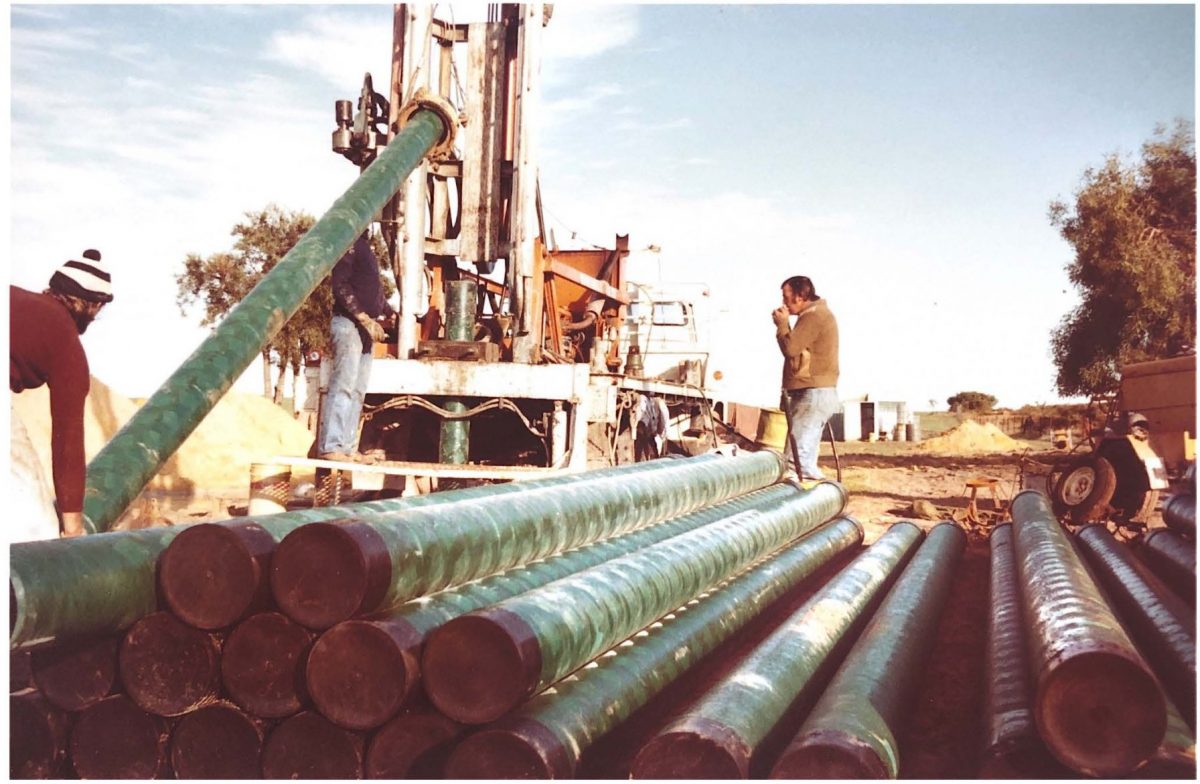
Rockwater designed and supervised the construction of seven high-yielding bores at Phosphate Hill, which supply up to up to 10 GL/annum for mining operations.  These bores are about 120 m deep and are also used for dewatering.

A numerical groundwater flow model was constructed by Rockwater in 1985 and has since been refined to predict water-level drawdowns in the mining area, and the longevity of the borefield. Measured drawdowns have closely followed predicted values. 

Phosphate Hill was Rockwater’s first job.

We continue to provide hydrogeological advice to the Phosphate Hill mine, including preparation of a mine closure plan.

ANALYSIS AND REPORTING
  • Test-pumping interpretation
  • Groundwater flow modelling
  • Field work reporting
  • Mine closure plan
FIELD METHODS
  • TEM surveys
  • Large-diameter production bore construction and testing

Similar Projects

More photos

Want to know more?

ENQUIRE FOR MORE INFO NOW
Read more

Dampier To Perth Gas Pipeline

DAMPIER TO PERTH GAS PIPELINEConstruction water supply

Where?
Western Australia
What?
Construction water supply
When?
1980-84

THE PROJECT

The Dampier to Perth natural gas pipeline was constructed in 1982-1984 for the State Energy Commission of WA.  About 1,600 km long, it links gas fields in the Carnarvon Basin to mining, industrial, commercial and domestic customers located from the Pilbara to the southern part of the state.

It is Western Australia’s most important piece of energy infrastructure. Since 1984 , the pipeline network has since been extended to the Eastern Goldfields and the South-West regions. 

For more info about this or similar projects
Talk to us today

OUR ROLE

Rockwater located, developed and tested water supplies at 12 borefields along the pipeline route in advance of construction commencing in 1982. The water was used for hydrostatic testing of the pipeline after each section was completed. Typically, 20 L/s of low-salinity groundwater were produced at each borefield.  We also proved-up groundwater supplies at many additional locations for pipeline-construction camps, constructing and maintaining access roads, and supplying compressor stations.

Source aquifers for the pipeline project ranged from sedimentary strata of the Carnarvon and Perth Basins, to fractured metamorphic rocks and river gravels.  Bores were constructed to depths in the range 30 m to 200 m below ground surface. Many of the borefields were located in remote areas with little no existing hydrogeological information. 

The water supply for the Dampier to Perth gas pipeline has been Rockwater’s largest water-supply project for infrastructure construction.   Twenty production bores were constructed for the hydrostatic testing, and subsequently made available for local use; some of which are still in operation.

ANALYSIS AND REPORTING
  • Geological and geophysical interpretation
  • Hydrogeological evaluation of borefield
FIELD METHODS
  • Air-photo interpretation
  • Resistivity surveys
  • RAB and air-core exploration drilling
  • Mud-rotary bore construction
  • Test-pumping
  • Evaluation of bore supply capacity
  • Water quality sampling

Similar Projects

More photos

Want to know more?

ENQUIRE FOR MORE INFO NOW
Read more

Glen Iris, Aqwest

GLEN IRIS, AQWESTMunicipal water supply to the City of Bunbury

Where?
Bunbury, Western Australia
What?
Municipal water supply
When?
2009, 2019

THE PROJECT

Aqwest provides high-quality drinking water to over 17,000 customers in the City of Bunbury and surrounding areas.  The supplies are obtained from production bores constructed in the Yarragadee Aquifer to depths of up to 460 m.

For more info about this or similar projects
Talk to us today

OUR ROLE

As part of Aqwest’s strategy of increasing its water supply and shifting extraction away from the coast (to minimise salt water intrusion), two production bores were drilled at the Glen Iris Water Treatment Plant under the supervision of Rockwater in 2009 and 2019.

The bores are capable of producing 110 L/s each, but are planned to be pumped at a combined rate of 140 L/s.

Rockwater has been providing hydrogeological services to Aqwest since 2002.

Since 2002, we have completed over 10 major projects for Aqwest similar to Glen Iris.

ANALYSIS AND REPORTING
  • Geological and geophysical interpretation
  • Feasibility study
  • Technical specifications according to AS400-1997 standards
  • Field investigation reporting
  • Annual compliance reporting
  • Planning for borefield development
  • Groundwater modelling
  • General hydrogeological advice
FIELD METHODS
  • Large diameter mud-rotary bores (406 mm pump chamber)
  • Down-hole geophysics surveys
  • Interval testing of permeability and water quality (TDS, pH, iron)
  • Pumping tests
  • Down-hole CCTV and Televiewer surveys

Similar Projects

More photos

Want to know more?

ENQUIRE FOR MORE INFO NOW
Read more

Ellendale Diamond Mine

ELLENDALE DIAMOND MINEMine water supply and dewatering

Where?
West Kimberley , Western Australia
What?
Mine water supply and dewatering
When?
1978-2014

THE PROJECT

During the Miocene, over 150 volcanic pipes erupted in the West Kimberley Province; about fifty of which intruded Permian and older sediments, collectively forming the Ellendale Diamond Field. 

The volcanic pipes are generally carrot-shaped at depth, but near the surface they frequently erupt outwards forming a wine-glass shaped structure. The pipes consist of magmatic lamproite cores with tuffaceous margins.  During the eruptive events, the country-rock sediments were super-heated and then, as they cooled, the sandstone adjoining the pipes recrystallised to form a hard quartzite rim, which commonly forms an aquiclude.

The tuffacous lamproite, containing the diamonds, is generally moderately to highly permeable and forms a significant aquifer. 

For more info about this or similar projects
Talk to us today

OUR ROLE

The Ellendale 4 and 9 pits were mined about 60 m depth, intersecting vuggy and highly permeable calcretised lamproite around the margins of the deposit.  Dewatering of the pits was achieved by 15 in-pit and ex-pit bores, depressurisation holes, and in-pit sumps.  The bores were designed and drilled under the supervision of Rockwater. 

Rockwater also designed and supervised the installation of a fresh water supply of 10 GL/annum from 23 bores of up to 300 m depth for processing of the ore by Dense Media Separation.  The project included extensive numerical modelling, and the preparation of hydrogeological assessments for mining proposals, licensing and submission to the EPA.

ANALYSIS AND REPORTING
  • Geological and geophysical interpretation
  • Groundwater modelling for dewatering and water supply
  • Field investigation and modelling reports
  • H3 level of Hydrogeological Assessment
  • Annual compliance monitoring reports
FIELD METHODS
  • RC exploratory drilling
  • Mud-rotary production bores 
  • Depressurisation bores
  • Down-hole gamma and resistivity logging 
  • Test-pumping
  • Water quality sampling
  • Stygofauna surveys
  • Vegetation and groundwater spring monitoring and condition surveys

Similar Projects

More photos

Want to know more?

ENQUIRE FOR MORE INFO NOW
Read more

Eneabba Mineral Sands Mine

ENEABBA MINERAL SANDS MINEWater supply to the largest heavy mineral sand mine in Western Australia.

Where?
Eneabba, Western Australia
What?
Mine water supply
When?
1975-99

THE PROJECT

The Eneabba heavy mineral sands deposit comprises fossil strandlines at Eneabba East, Eneabba South, Eneabba West and Depot Hill.  The deposit Is 40 km long and up to 9 km wide.  It was developed using strip mining, hydraulic mining and dredging. 

Eneabba was the largest heavy mineral sand mine in Western Australia. 

For more info about this or similar projects
Talk to us today

OUR ROLE

Rockwater supervised the drilling of sixty hydrostratigraphic holes, 57 of which were completed as production bores.  The production and associated monitoring bores were constructed to 20-700 m depth in the Superficial, Yarragadee and Cattamarra aquifers of the northern Perth Basin.

The borefield supplied up to 21 GL/annum for ore-processing.  This is equivalent to one-third of the current groundwater water supply to Perth, and makes Eneabba the largest mine water supply project to have been conducted by Rockwater.

Rockwater is currently involved with the plugging and abandonment of decommissioned bores at Eneabba.  During borefield operation, we also conducted extensive studies into bore corrosion, clogging of the reticulation system with iron-reducing bacteria and developing methods by which these could be controlled. 

Rockwater has been proving hydrogeological services to the Eneabba Sands Mine since 1975, during which have completed over 20 projects.

ANALYSIS AND REPORTING
  • Bore completion reports
  • Geophysical interpretation reports
  • Groundwater Licence Operating Strategies
  • Aquifer reviews for submission to regulatory authorities
  • Modelling of water losses from dredge ponds
  • Modelling of Yarragadee, Cattamarra and Superficial Aquifers  
  • Borefield maintenance schedules
  • Borefield status reviews
  • Waster balances 
  • Iron reducing bacteria investigation and remediation reports 
  • Life of Mine final void rehabilitation 
  • Plugging and abandonment completion reports
FIELD METHODS
  • Supervision of drilling, and bore development and testing
  • Rehabilitation of production bores
  • Lithological logging
  • Sieve analyses
  • Hydrostratigraphic hole and borehole geophysical surveys 
  • Surface electromagnetic geophysical surveys
  • Groundwater sampling 
  • Plugging and bore abandonment

Similar Projects

More photos

Want to know more?

ENQUIRE FOR MORE INFO NOW
Read more

St Ives Gold Mine

ST IVES Gold Mine water supply project

Where?
Kambalda, Western Australia
What?
Mine water supply
When?
Since 2003

THE PROJECT

St Ives, operated by Gold Fields, is one of the largest gold mines in the Eastern Goldfields region of Western Australia, having produced over 10.5 million ounces of gold since the mid-1980s.  About 2 GL/a (60 L/s) of saline groundwater is used to supply a 4.5 Mtpa mill at Kambalda.  The water is obtained from a borefield near Widgiemooltha, which draws from a major Tertiary palaeovalley sand aquifer.  Over 50 GL have been extracted from the aquifer since 1991.

For more info about this or similar projects
Talk to us today

OUR ROLE

Rockwater designed and supervised two air-core exploration programmes in 2003 that led to the establishment of eight new production bores, mainly targeted to exploit groundwater mounds between existing bores.

We also regularly use a groundwater model to predict the capacity of the aquifer and provide advice on the pumping schemes needed to optimize the borefield’s longevity.

A TEMPEST airborne electromagnetic survey is being conducted to explore for extensions to the Mt Morgan aquifer and other palaeovalley aquifers in the region.

ANALYSIS AND REPORTING
  • Geological and geophysical interpretation
  • Groundwater flow (drawdown) modelling
  • Groundwater density (salinity) modelling
FIELD METHODS
  • Air-core exploration
  • Down-hole electromagnetic induction and gamma surveys
  • TEMPEST AEM survey

Similar Projects

More photos

Want to know more?

ENQUIRE FOR MORE INFO NOW
Read more

Busselton Water, Water Supply Project

BORE BWB 17, BUSSELTON WATERWater supply and modelling in collaboration with Busselton Water

Where?
Busselton, Western Australia
What?
Municipal water supply
When?
1985, 2015

THE PROJECT

Busselton Water provides up to 7.5 GL/annum of high-quality drinking water to the City of Busselton and surrounding areas.  The supplies are primarily obtained from production bores constructed within the Yarragadee Aquifer.

For more info about this or similar projects
Talk to us today

OUR ROLE

One of the main bores, BWB 17, was drilled to 600 m depth and constructed with a carbon-steel pump chamber and intermediate casing, which gradually suffered from pitting corrosion. The bore was design by Rockwater to allow for sufficient annular clearance for it to be relined.

In 2015, after 30 years of operation, BWB 17 was relined by inserting thin-walled stainless-steel casing and cementing it in place with a one-shot grouting packer.  The bore has continued to supply about 1 GL/annum, with an instantaneous flow rate of 95 L/s.

Rockwater has been providing hydrogeological services to Busselton Water since 1980.

Since 1980, we have completed over 15 major projects for Busselton Water, similar to BWB 17.

ANALYSIS AND REPORTING
  • Preparation tender specifications
  • Evaluation of tenders
  • Field investigation reporting
  • Annual compliance reporting
FIELD METHODS
  • Down-hole CCTV surveys, pre- and post-relining
  • Caliper survey for identification of obstructions and cement volume calculation
  • Casing collapse strength calculation 
  • Design and supervision of relining 
  • Supervision of bore development
  • Optical Televiewer and Acoustic Televiewer surveys
  • Supervision of pumping-tests for bore efficiency calculation

Similar Projects

More photos

Want to know more?

ENQUIRE FOR MORE INFO NOW
Read more

Perth Groundwater Replenishment Scheme

PERTH GROUNDWATER REPLENISHMENT SCHEMEWater supply and managed aquifer recharge in collaboration with Water Corporation

Where?
Perth, Western Australia
What?
Municipal water supply and managed aquifer recharge
When?
2010, 2018

THE PROJECT

Declining rainfall and streamflow have resulted in dams being replaced by desalination and groundwater as a major source of drinking water for Perth.

A major groundwater replenishment scheme is being implemented by Water Corporation to augment Perth’s water supply.  The scheme involves treating waste water to potable standards, injecting into it deep, confined aquifers of the Perth Basin, and re-capturing the water when required. 

Groundwater replenishment has the potential to supply 20% of Perth’s drinking water by 2050.

For more info about this or similar projects
Talk to us today

OUR ROLE

Rockwater was engaged in Stage 1 of the scheme in 2012 to supervise and log the initial 650 m deep hydostratigraphic diamond hole and for ongoing hydrogeological support. 

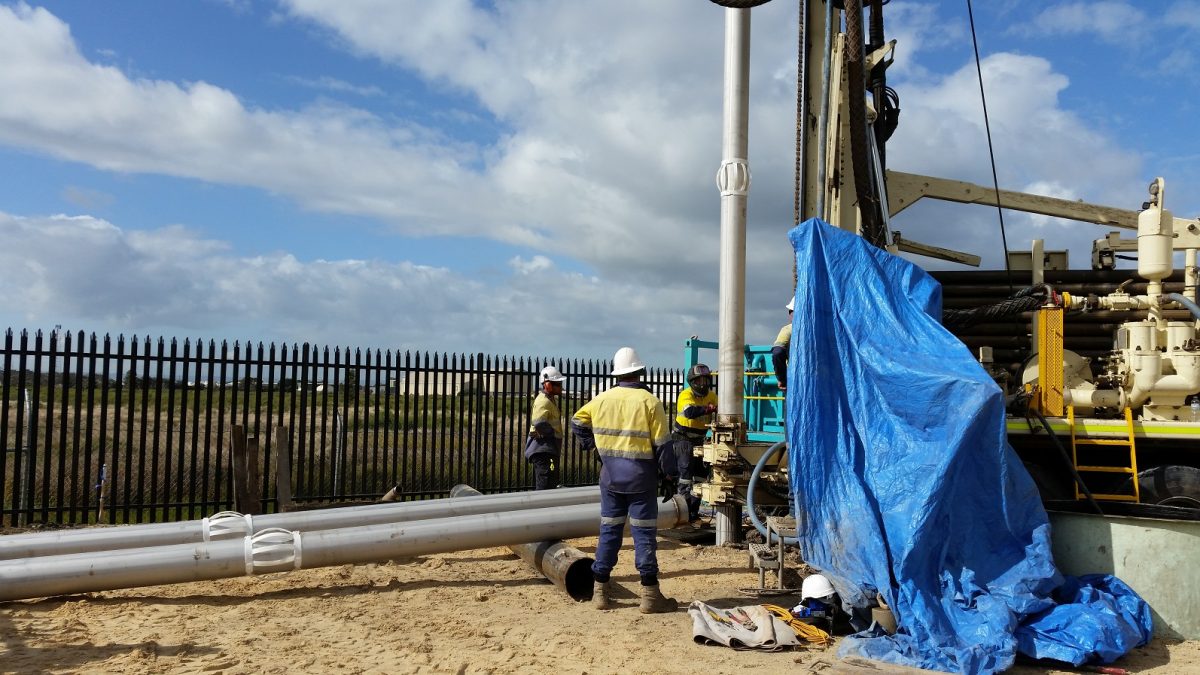
In 2018, as part of stage 2 of the scheme, we provided 24/7 hydrogeological supervision for the drilling, construction and testing of 16 injection, extraction and monitoring bores to depths of up to 1,400 m.

Drilling of the bores relied heavily on techniques used in the oil industry that had not been widely applied for groundwater development in Western Australia.

Rockwater has been providing hydrogeological services to Water Corporation since 1987.

Since 1987 , we have completed over 120 projects for Water Corporation at over 50 locations, ranging from Albany to Wyndham.

ANALYSIS AND REPORTING
  • Geological and geophysical interpretation
  • Correlation of geological and geophysical data with drilling parameters (penetration rate, weight on bit, torque, mechanical specific energy, hole deviation, etc) using Wellcad software
  • Pumping test analysis using AQTESOLV software
  • Clogging risk assessments
  • Groundwater modelling
  • Field investigation reporting
  • Annual compliance reporting
FIELD METHODS
  • Logging of core and drill cuttings
  • Real-time and post-drilling down-hole geophysical surveys
  • Flow logs during pumping tests
  • Nuclear magnetic resonance surveys
  • Mud-rotary bores
  • Pumping tests (up to 160 L/s)
  • Membrane filtration testing
  • Injection tests
  • Clogging testing

Similar Projects

More photos

Want to know more?

ENQUIRE FOR MORE INFO NOW
Read more

Tjuntjuntjara Community

TJUNTJUNTJARA COMMUNITYExploring freshwater aquifers to supply the Tjuntjuntjara community.

Where?
Nullabor Plain, Western Australia
What?
Community Water Supply
When?
2017

THE PROJECT

Tjuntjuntjara is a remote Aboriginal community in the Central Desert region of Western Australia. The community water supply is sourced from a small freshwater aquifer below a topographic low, locally known as a ‘donga’.  Recharge from rainfall displaces the regional saline groundwater beneath the donga forming a freshwater lens.

For more info about this or similar projects
Talk to us today

OUR ROLE

Rockwater was engaged by the Department of Communities (Housing) to upgrade the community water supply infrastructure at Tjuntjuntjara.  A new operating protocol was developed to minimise the risk of saline intrusion.

Rockwater also installed a borefield telemetry system to provide real-time water level and salinity data to an online portal, including alarms and notifications when water level and salinity trigger levels are exceeded. This enables Housing to adaptively manage the fresh water lens aquifer and provide a continuous supply of fresh water to the community.

ANALYSIS AND REPORTING
  • Development of an online monitoring data portal
  • Assessment of test-pumping data
  • Development of a borefield management plan 
  • Development a groundwater license operating strategy
FIELD METHODS
  • Test-pumping
  • Borefield audit and bore headwork repairs
  • Telemetry installation

Similar Projects

More photos

Want to know more?

ENQUIRE FOR MORE INFO NOW
Read more